Setting Up the Board
Klondike uses a standard 52-card deck (no Jokers). After shuffling, 28 cards are dealt into seven columns — the tableau. Column 1 has 1 card, column 2 has 2, column 3 has 3, and so on through column 7. In each column, only the top card is face up; every card beneath starts face down.
The remaining 24 cards form the stock, placed off to the side as the draw pile. Next to the stock sits an empty waste slot, where cards go after you draw them. Above the tableau are four empty foundations — one per suit. Your job is to migrate every card to its correct foundation.
The board below is a live playable opening deal — click cards to move them, tap the stock to draw. It's isolated from your main game, so nothing you do here affects your saved game.


The Four Pile Types
Tableau — the seven building columns
The tableau is the main play area. You build cards downward in alternating colors: a red 6 can sit on a black 7, and a black 9 on a red 10. Whenever the last face-up card in a column is moved off, the face-down card below flips automatically and becomes the new playable card.
Stock and Waste — your draw pile
When no tableau move helps, click (or tap) the stock to flip cards into the waste. The top waste card is always playable — you can move it onto a tableau column or up to a foundation. When the stock empties, click the empty slot to recycle the waste back into a fresh stock. StillDeck allows unlimited recycles.
Foundations — where suits live
Four empty slots, one per suit. Each starts with an Ace. Build upward in the same suit: Ace → 2 → 3 → … → King. Foundations are one-way in traditional Klondike — once a card is sent up, you rarely bring it back — which is why you'll want to think before promoting aggressively (see common mistakes below).
Valid Moves
Tableau to tableau
One rank lower, opposite color. Black 5 onto red 6 ✓. Red 4 onto red 5 ✗ (same color). Red Queen onto black King ✓.
Multi-card moves
You may move a descending, alternating-color run as a single unit. For example, a face-up sequence of red 6 → black 7 → red 8 moves together onto a black 9.
Empty tableau columns
Only a King — or a run starting with a King — may fill an empty column. This is a defining Klondike constraint. It's why emptying a column before you have a usable King is a trap.
To the foundations
Same suit, one rank higher than what's there. 5♠ onto 4♠ ✓. Foundations only accept ascending single-suit cards.
Your First Moves — 3 Scenarios
Three pre-dealt boards, each with one goal. The board detects when you hit the goal and marks it done. Only legal moves land. Scroll past any scenario you don't feel like playing — they run independently.
Scenario 1 — Play your first Ace
Aces start every foundation pile. Find an Ace on the board (or draw from the stock until one appears) and click it to send it up. Once any Ace lands on a foundation, the goal marker turns green.


Scenario 2 — Expose a face-down card
Every face-down card you flip opens up new options. Make any legal move that removes the last face-up card from a tableau column — the card beneath flips automatically.


Scenario 3 — Build 5 cards to the foundations
The real game. Chain moves together — draw from stock, build on the tableau, promote Aces and 2s — until five cards (of any suits) are sitting on the foundations. This is where planning two moves ahead starts to pay off.


Turn 1 vs Turn 3 — Which Draw Mode?
Klondike has two common rules for drawing from the stock. Most solitaire apps let you pick; StillDeck defaults to Turn 1 for new players.
| Mode | How it works | Winnability |
|---|---|---|
| Turn 1 | Flip one card at a time from the stock. Every stock card is reachable in order. | ~43% (mathematical ceiling) |
| Turn 3 | Flip three cards at once. Only the top of each batch is immediately playable. | ~11% (roughly four times harder) |
Recommendation for beginners: Start with Turn 1. Get the pile logic into muscle memory, then switch to Turn 3 for a real challenge. Curious how often players actually win? See the odds of winning Solitaire below.
Ready for Turn 3? See the Klondike Draw 3 rules & strategy guide →
How Difficult Is Solitaire? The Odds
Not every deal is winnable. The mathematically highest possible Klondike win rate, under "thoughtful" rules where you see every card before playing, is approximately 82% (proven by computer analysis). With normal hidden-card play, the ceiling drops to roughly 43% for Turn 1 and 11% for Turn 3 — about four times harder. So if a board feels impossible, it might genuinely be impossible.
| Condition | Win rate |
|---|---|
| Turn 1, thoughtful play (see every card) | ~82% (mathematical ceiling) |
| Turn 1, normal hidden-card play | ~43% |
| Turn 3, normal hidden-card play | ~11% |
| Experienced human, Turn 1 | 30–40% (in practice) |
| StillDeck players, last 30 days, Turn 1 | 42.2% (260 wins / 356 losses) |
Our live platform data essentially matches the theoretical Turn-1 ceiling. So if you feel like you're losing a lot: you're not alone, and many of those deals genuinely can't be won. Undo is free — use it to learn a line without restarting.
How we calculate this: the StillDeck row is
rolled up from GA4 custom events
(game_won / game_lost) over a
rolling 30-day window, no sampling. Refreshed monthly —
last refresh April 2026.
Winning the Game
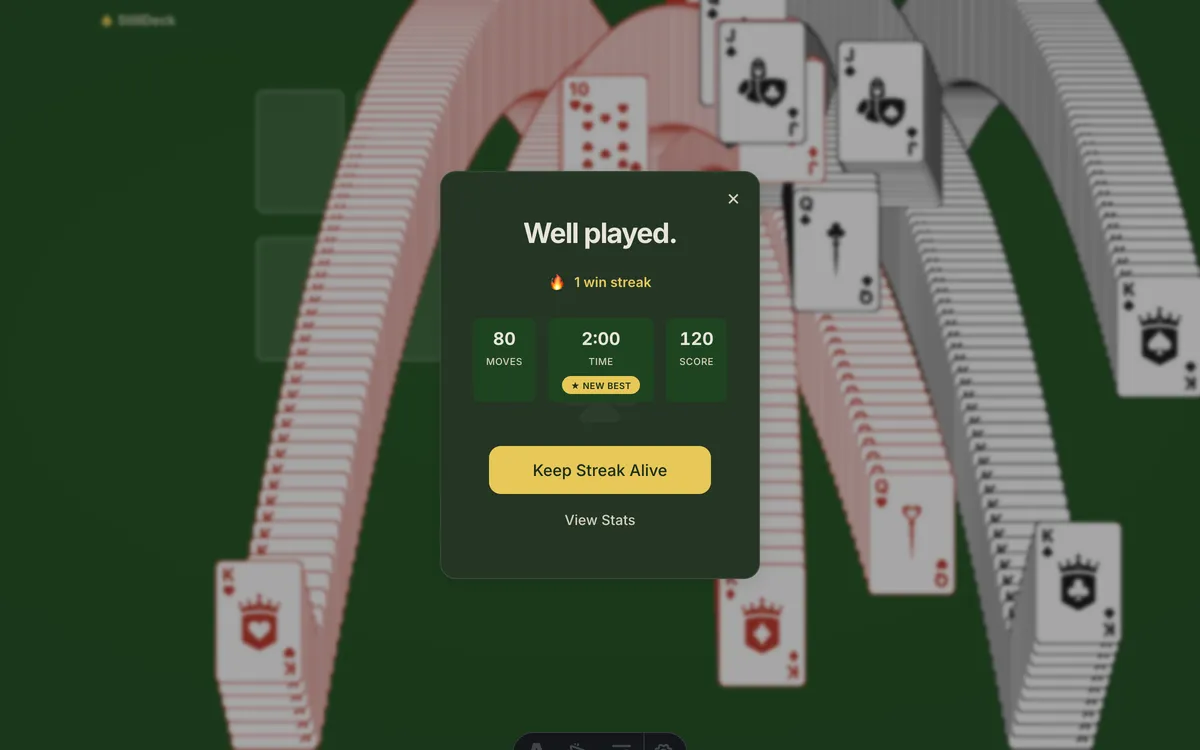
When every card has reached a foundation — all four suits built Ace through King — the game is won. StillDeck celebrates with a Windows 98-style cascading card shower (worth playing through at least once).
7 Common Beginner Mistakes
Every beginner loses winnable games for the same handful of reasons. Each card below shows the trap on the front; tap to flip and see the move that actually wins.
Scoring (Optional)
Most people play Solitaire for the satisfying shuffle of cards finding their home, not for a score. StillDeck uses the classic Microsoft scoring rules (+10 per foundation move, bonuses for flipping face-down cards, penalties for moving cards back off foundations).
Full scoring breakdown — Standard and Vegas systems, point values, and the Turn-3 recycle penalty — on the Klondike Rules scoring section →
Scores aren't shown by default — find them in Stats if you want to compete with yourself. Your best time and longest win streak are usually the more honest measures of how well you're playing.
The Tools You Have
StillDeck's Klondike ships with a few quiet helpers. All free, all opt-in, all working the moment the page loads.
- Undo — press U. Rewind any mistake; the fastest way to learn a line without restarting.
- Hint — press H. Spotlights one playable move; does not make the move for you.
- Restart — press R. Replays the same deal from the top, same seed, same draw mode.
- Install as an app — add StillDeck to your home screen (Chrome, Safari, Edge). Works fully offline once installed.
- Themes — five card felts (forest, slate, linen, ivory, felt green). Settings → Theme.
- No ads, no sign-up, no tracking — every feature above works without an account, on any device, forever.
Play the Full Game
No ads, no sign-up, no tracking beyond what you opt into. Just Klondike, cleanly.

Solitaire Variants: Klondike vs FreeCell vs Spider vs Pyramid
"Solitaire" usually means Klondike — the default since Windows 3.0 in 1990. The other variants share the name but change the deck, the layout, or the win condition.
| Variant | Decks | Layout | Key rule | Win rate |
|---|---|---|---|---|
| Klondike (this page) | 1 × 52 | 7 tableau columns, hidden stock | Build down alt-color; foundations up by suit | ~43% (Turn 1) |
| FreeCell | 1 × 52 | 8 columns, 4 free cells, all cards face-up | No stock; use free cells to park cards | ~99% solvable |
| Spider | 2 × 52 | 10 columns, 50 hidden cards | Build down by rank; clear full suits to foundations | ~30% (4-suit) |
| Pyramid | 1 × 52 | 28-card pyramid + stock | Pair cards that sum to 13 to discard | ~0.5% (perfect clear) |
FreeCell is also available on StillDeck. Play FreeCell free →
Solitaire Terminology — a Quick Glossary
A handful of terms come up in every Klondike rulebook. Learn them once and every guide on the internet reads cleanly.
- Tableau
- The seven working columns where you build down in alternating colors.
- Stock
- The face-down draw pile. Tap to flip cards into the waste.
- Waste
- Where drawn cards land face-up. Only the top waste card is playable.
- Foundation
- One of four suit-specific piles above the tableau. Built upward from Ace to King.
- Run
- A valid sequence of face-up tableau cards (descending rank, alternating colors) that can be moved together.
- Promote
- Moving a card from the tableau or waste up to a foundation.
- Pip
- The suit symbol on a card (♥ ♦ ♣ ♠). Also the rank symbols on numbered cards.
- Recycle
- Turning the empty stock back into a fresh deck after the waste cycles through. StillDeck allows unlimited recycles.
Frequently Asked Questions
Click any question to expand.
Is every solitaire game solvable?
No. Roughly 80% of Klondike deals are theoretically solvable with perfect play, which means about 1 in 5 games cannot be won no matter how you play. StillDeck never discards unsolvable deals — that is part of the real Klondike experience. If a game looks stuck, use a hint or start a new deal.
Can you lose a game of solitaire?
Yes. A game is lost when no more legal moves are possible and the foundations are not complete — for example, when every card in the stock has been cycled without any playable options. StillDeck detects this state automatically and lets you restart or start a new deal.
What is the difference between Draw 1 and Draw 3?
In Draw 1, you flip one card at a time from the stock, making every card accessible in order. In Draw 3, three cards flip at once but only the top card is playable. Draw 3 is harder and requires more strategic planning.
Is StillDeck the same Solitaire I played on Windows?
Yes — same rules, same deal logic, same two draw modes (Turn 1 / Turn 3), same Ace-to-King foundation build. StillDeck is a modern, browser-native rebuild of the Klondike Microsoft bundled with Windows since 1990, with themes, up to 100 undos, offline play, and no ads. If you enjoyed the old one, you already know how to play this one.
What's the difference between Klondike, FreeCell, and Spider solitaire?
When people say "solitaire," they almost always mean Klondike — the variant Windows bundled since 1990 and the most widely played single-player card game in the world. FreeCell deals every card face-up and has almost-always-winnable deals. Spider uses two decks and builds down by rank regardless of suit. Pyramid is a matching game. StillDeck plays classic single-deck Klondike (Draw 1 and Draw 3).
How long does a game of Solitaire take?
A typical game takes 3–10 minutes. A fast win can land in under two minutes; a deep, thoughtful Turn-3 game can run 15+. StillDeck tracks your best time per draw mode so you can chase a personal record.